
All (some?) things volcano!

Using icequakes to recover inter-station impulse responses on Erebus volcano through Bayesian optimized coda correlations
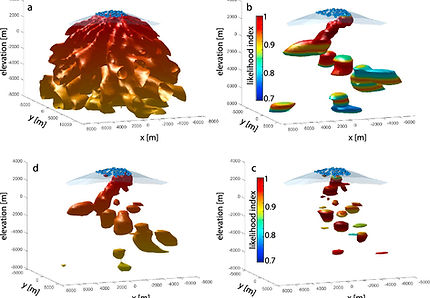
Advanced matrix image of Erebus volcano derived from the first few singular values of the reflection matrix (Blondel et al 2019)

The Valles Caldera supervolcano

For a seismologist, volcanoes are essentially end-member structures in terms of complexity, dynamic behavior, and general method-breaking targets. Most conventional methods of imaging tend to fail on volcanoes for various reasons: Extreme topography complicates tomographic efforts; extremely short mean free path statistics turn any input source into an incoherent mess over very short distances, and a volcano's dynamic behavior means known structures may shift and change over many different time scales.
UTEP is currently the host for the Mount Erebus Volcano Observatory (MEVO), and we are in the process of setting up a data and code portal for this unique volcano that serves as a natural laboratory.
The extreme scattering structure of Erebus volcano is currently being used to develop and test a specialized avenue of scattering-based imaging (in much the same way as a baby ultrasound works, except with the advanced capability of "seeing" through a dense fog of other structures). A few recent studies on this can be found in my publications section.
Furthermore, volcanoes generate all sorts of interesting signals, from eruptions, tremor, icequakes, environmental forcing like storms and accumulation/melt cycles, iceberg tremors (in the case of Erebus), and local/teleseismic signatures. As such, continuous seismic recordings offer unique opportunities to tune unsupervised learning algorithms that are able to blindly classify various kinds of transient signatures, in a sort of clustering of behaviors inherent to any raw data set. Many other such projects of opportunity exist with this flexible and soon to be real-time dataset.
An example of current forays at Erebus involves studying the long standing problem of locating small distributed events on the volcanic edifice, which is classically frustrated by strong scattering and a general lack of clear P and S phases. Icequakes in particular are quite difficult to locate, given strong local velocity variations and no conventional metric of event distance. As a first real push toward solving this problem, we are systematically addressing the two primary (and separate!) problems: 1) Distance is recorded in the shape of the event envelope, not by any clear recording of ballistic phases and 2) Velocity models are difficult to constrain given topography and logistics, particularly for higher frequency information. The first of these problems implies constraining the scattering characteristics of the edifice, a feat best accomplished by modeling the 3D elastic radiative transfer equation using Monte Carlo particle methods (this essentially approximates the absolute amplitude information on average carried by a statistical average of scattering parameters in the edifice). The shape of the envelope and its emergent ballistic front inform on event distance, while the temporal offset of the envelopes informs on deviation from some average velocity along the path. Although a joint location/tomography is possible in this way, an independent surface wave velocity model can be assembled passively by leveraging both ambient and icequake coda correlations, the combination of which yield broadband dispersion curves up to 10 Hz (see below). Keep your eyes open for a pair of papers on the subject in 2026-2027.
Along with scientists at the University of New Mexico, we have also recently deployed a large nodal seismic array through the Valles Caldera, super-volcano in NM, with a goal to better understand its magmatic structure (which largely remains a mystery to date). The field work and data have been performed using a joint PASSCAL/UTEP instrument pool, and the project is now in its closing term. Several high-profile papers have been published, and the first seminal shear wave model can be found at: https://agupubs.onlinelibrary.wiley.com/doi/full/10.1029/2022GL101520
Furthermore, a secondary large scale nodal deployment has allowed for broad caldera coverage, and permitted a radial anisotropy study, published as of 2026 in Nature:
https://www.nature.com/articles/s43247-026-03214-7
Work is ongoing to leverage dispersion curves and H/V ratios to attempt a more accurate mapping of the extent of the shallow magma body under the resurgent dome, which to date is unconstrained. A follow up densification project is being considered to help bolster imaging of newly revealed structures.
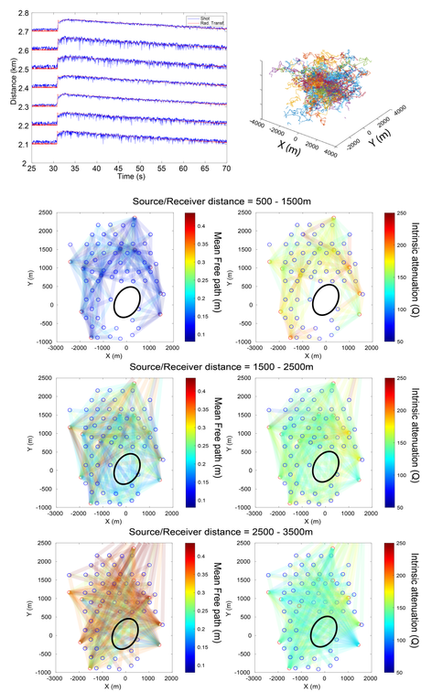
Monte Carlo simulations of 3D elastic radiative transfer for explosive shots on Erebus volcano, showing spatially variable mean free path relationships

Direct constraint on source/receiver offset scattering mean free path on Erebus (left). Jointly resolved icequake coda and ambient noise correlations that are capable of producing a combined broadband dispersion curve suitable for upper edifice velocity inversions.
Shear wave velocity model for the line transect of the Valles caldera (Wilgus et al 2023)
As of 2024, we are also funded by NSF's CAIG foundation in collaboration with staff scientists at PNNL to study deep learning models with the goal of blindly clustering continuous array-based data into families. This is a difficult and under-developed branch in the literature with the promise of massive benefits, and we are currently using Erebus volcano's well-documented datasets of icequakes, eruptions, iceberg tremor, and other exotic events as a benchmark to generalize to other glaciated volcanoes. That being said, the sort of approach we are developing is applicable in theory to any dataset whatsoever with adequate training.
Recent advances in deep learning architectures, in particular related to the capture of array-based time series through neural and graph operator blocks, have inspired our current working architecture as described below. Several initial papers are anticipated in 2026-2027.


Top: A blind clustering prototype successfully segmenting icequake and Strombolian eruption signatures from spectrograms, a notoriously difficult task without array phase based information. Bottom: Prototypical architecture based on neural operator cascades. Fourier neural operators learn spectral bases for the data, while graph operators encode array based information (such as moveout phase etc). A variational constraint can further be added in a similar fashion to figure 2, or we may directly use variational operators. A version of this architecture (PhaseNO, Sun 2023) has demonstrated the ability to capture array based information for earthquake detection and phase picking.