

Desert seismology, and listening for wind and particles
This recently funded project through the Army Research Lab (ARL) aims to explore links between wind turbulence, airborne particle budgets, and the ambient seismic spectrum for dryland morphologies. Recent forays in physical modeling have produced a number of closed-form models of the seismic impact of particle and debris flows generated by river sediment transport and avalanches. These models help predict the shape of the resulting spectrum due to spatial and temporal averages of individual particle impacts.
Particularly for dryland morphologies, this principle also applies, but the phenomenology is likely far more subtle and difficult to constrain (i.e., the particles are saltating and bouncing around in the wind, but each particle carries FAR less kinetic energy than a boulder rolling downhill, for instance). Particle and dust transport is however a very important aspect of monitoring erosion, air quality, and vulnerability in desert climates. A direct link to ambient seismic signals, with the added advantage that seismometers do not directly interact with the atmospheric system, is thus a desirable objective, but requires considerably more cross-disciplinary data.
As such, we have partnered with the Meteorological Sensor Array in the Jornada Range, NM, which features a very advanced battery of meteorological sensors aiming to model fluid dynamics of high-wind turbulence, to deploy a joint array of seismic nodes and real-time particle sensors to better constrain the subtle relationships between wind shear, turbulence, particle saltation and budgets, and the ambient seismic spectrum, with a goal to study potential empirical laws dictating particle transport from seismic signals alone. This project is now complete: We'll have a neat grain saltation paper published shortly, with implications for tracking erosion through the seismic spectrum. Stay tuned!
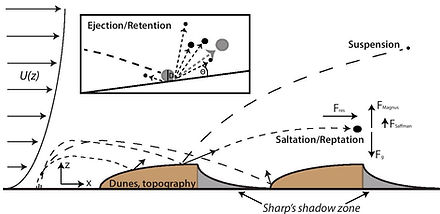
Schematic of particle saltation under the influence of a wind shear profile

Proposed seismic array and MSA meteorological array in the Jornada Range, along with example instrumentation

Feedbacks and other effects relating atmospheric forcing to particle budgets and the ambient seismic spectrum