
Ice shelves and climate variability: Several proposals in review and in construction
Ice shelves are the canaries in the mines of climate change. West Antarctic ice shelves in particular, have undergone significant ice mass loss over the last few decades, and we suspect events like the collapse of Larsen B will become more frequent.
Although collapsing ice shelves do not themselves contribute to sea level rise (since they are already floating), they do however act as buffers to slow down the flow of grounded ice in abutting ice sheets (the real heavy hitters of sea level rise). Lose the shelf, and the ice sheet begins to destabilize. What's more, healthy ice shelves are coated with a thick snow-to-ice layer called the firn, which acts as an insulator for the solid ice beneath it. Lose the firn, lose the shelf, lose the sheet (this is, among a few other factors, what happened to Larsen B).
I am currently studying a novel approach to seismically monitor the firn, and evaluate its response to climate forcing on the Ross Ice Shelf, Antarctica. This involves looking at long records of ambient seismic noise, which feature unique near-surface trapped resonance signatures, that look (and sound!) a bit like a dissonant choir. Our initial findings, published in late 2018, caused a bit of a stir, which was followed by a multi-year media storm.
Since then, we've published 3 more papers on the subject, have presented a sequence of talks and webinars, and have developed a whole slew of art/science collaborations, including works by Canadian artist Sandra Volny (https://sandravolny.com/) who does some very neat work involving chemical "fossilization" of sound records.
A good solid reference to understand and experience the process and implications of sonifying ice shelf sounds can be found here:
Figure 3 and 4 on the right show a few tidbits of that research: The colorful panel represents the amplitude spectrum (as a spectrogram of continuous seismic noise) showing amplifications at certain frequencies (the red lines/blobs) that drift around when impacted by surface forcing (in this case, large passing storms that deposit snow and rearrange structures). This drifting behavior can be used to understand what the firn is "feeling" as a response to anything happening on the surface (for instance, it is also responsive to swings in temperature!)
These spectral peaks also feature anisotropy (that slight offset of the blue and red lines in the bottom panel of the third figure), which is to say, seismic waves travel faster in one direction than another, pointing to preferential structures in the snow and ice (like directional crevassing and plastic deformation and stretching of snow).
A follow up proposal to NSF is in the works to deploy a 3D multi-instrument array on the RIS to help constrain and study this otherworldly phenomenon, and another is already in review to study this phenomenology on the 1000+ nodal seismic network deployed as part of the Thwaites Interdisciplinary Margin Evolution (TIME) experiment. Student opportunities are expected in the coming year.
Examples of fossilized sounds from Sandra Volny's studio (Fonderie Darling, Montreal)


Figure 1: The Ross Ice Shelf, in all its quiet glory

Figure 2: NASA study of mass loss from West Antarctic ice shelves over the last few decades

Figure 3: Variation of firn resonance modes as impacted by winds and steady state conditions. Right panel: Spectrogram of resonances modified by passing storms.
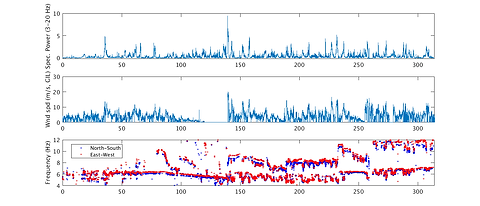
Figure 4: Wind and spectral power, and a clear view of anisotropy (splitting) in the resonance modes.

Figure 5 (with sound!): An example of "Ice Ghosts" depicted by wandering, dissonant spectral peaks noted in spectrogram above, along with the associate raw trace. The associated sound file is the Griffin-Lim processed audio of the above data. Note that 15 days of data are compressed to roughly 8 minutes of audio. Interesting periods to listen to are at the beginning of the file and that particularly loud, variable period toward the end.
As part of a multi-year media frenzy on the subject, Colbert coining the term "ice ghosts" from right under our scientific noses.